
ShowcaseBoxkin, sample brand
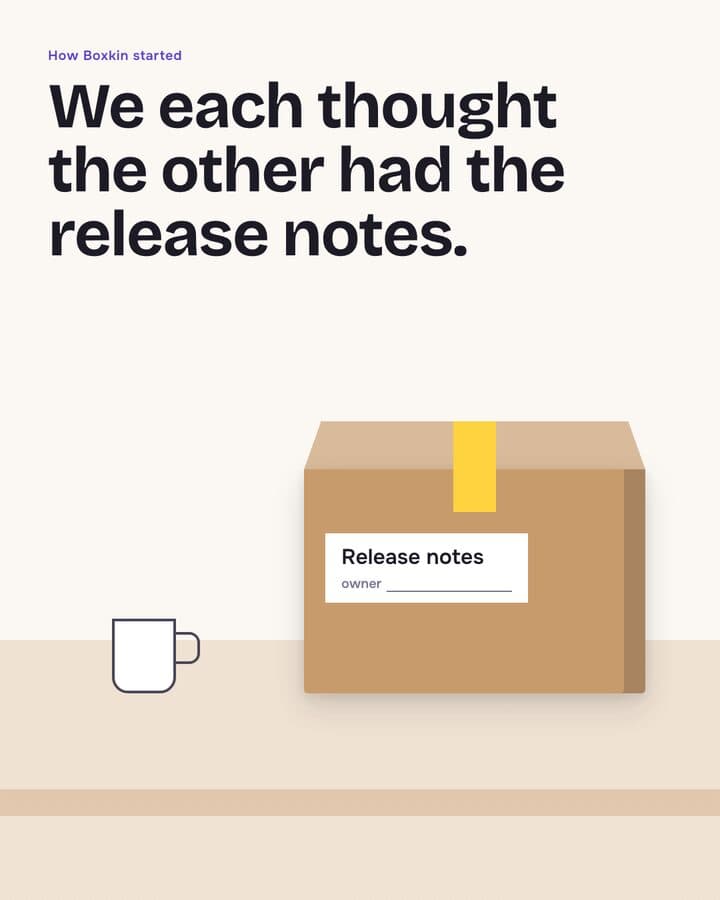
We each thought the other had the release notes
Carousel · 4:5. Built at 1080 × 1350 px.
Boxkin is an invented brand from the app’s sample library. It has no customers and no product, so every figure, name and offer in this piece is fictional. The piece itself is a finished build: it went through the same brief, checks and approval as any other.
What the brief asked for.
From brief.md, the written brief, locked before anything was designed.
Everything in the sections below is quoted from the files this build left behind. Nothing is summarised.
- Audience
- leads of small teams (3 to 30 people) who each do three jobs and have lived a handoff that fell between two people
- The one idea
- in 2022 our launch slipped because two of us each thought the other had the release notes; Boxkin is the fix we wished we had that week, one owner per box and a note when it moves
- Format
- feed
- Ratio
- 4:5
- Imagery
- props-only
- Why that imagery
- Boxkin is fictional with no product shot and no founder photo, so the story is drawn from objects: a kraft box, a note, tape and release-notes paper
- What success looks like
- at thumbnail size "ha, that's our Friday"; by slide 6 "one owner per box, okay, I get it"; swipe-through to slide 6
- Route
- R1 + 0
- Route 0
- the founding story told in six text slides
- The Route picked
- R1 + 0
Notes
Carousel of 6 slides. Arc: 1 hook (the slipped launch, "we each thought the other had it"); 2 who we were (a team in Lisbon, 2022, release day); 3 the miss (nobody owned the release notes); 4 the idea (one owner at a time, a note on the box, accept before it is yours); 5 what changed (Monday 9:00 digest: boxes you own, boxes waiting on you); 6 end slide, logo + "Start free" pill.
Middle slides carry no logo. CTA: "Start free".
Copy speaks as "we". No named founder, no invented quote, no faces, no named people (no Marta/Rui), no app UI or chat cards.
Facts only from brand/BRAND.md: team of nine in Lisbon, started 2022. At most one demo stat (slide 5), e.g. 71% of boxes passed on a Friday are accepted by Monday noon.
V2 risk: the type must be set huge and act as the image, or the 60% visual rule fails at preflight.
The lead visual device, and why.
From patterns.json, where each variant declares what it leads with.
V1
one plain kraft box travelling a continuous desk panorama, crossing every slide seam
One kraft box nobody owns slides across all six slides, and every swipe pushes it one step closer to the slipped launch (Route R1, chain-reaction).
The caption and the rest of copy.md.
The words that ship beside the artwork. copy.md is the build’s caption file.
Caption
In 2022 our launch slipped because two of us each thought the other had the release notes.
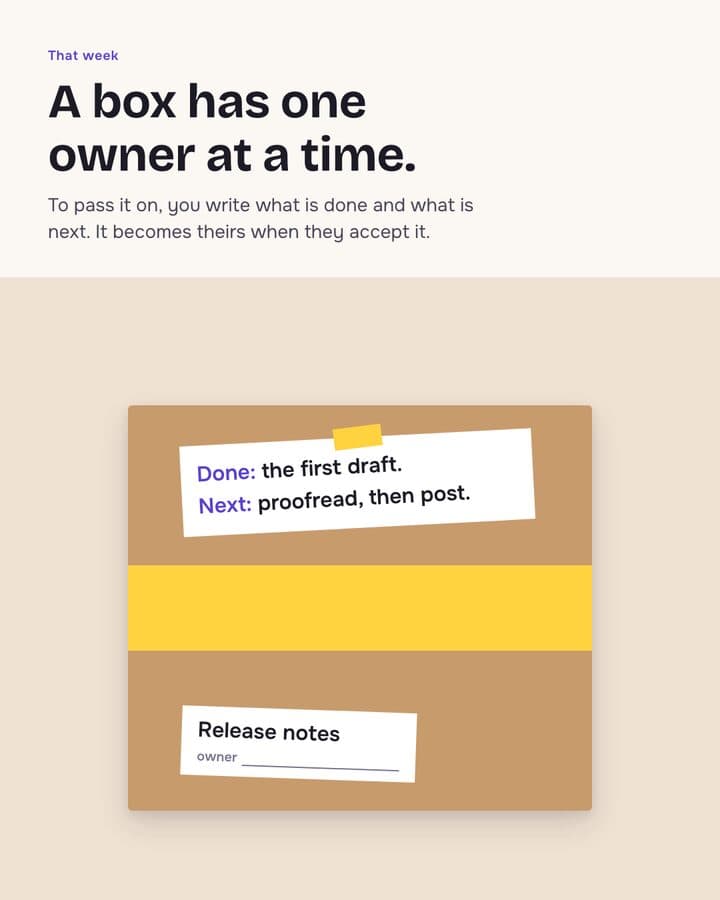
That week we decided every piece of work should have one owner at a time. In Boxkin each task is a box. To pass one on, you write what is done and what is next, and it becomes theirs when they accept it.
Start free to boxkin.example
Caption
Boxkin started with a launch that slipped. It was 2022, we were a small team in Lisbon, and the launch was set for a Friday. The release notes were on the list with no name next to them. Each of us was sure the other one had them.
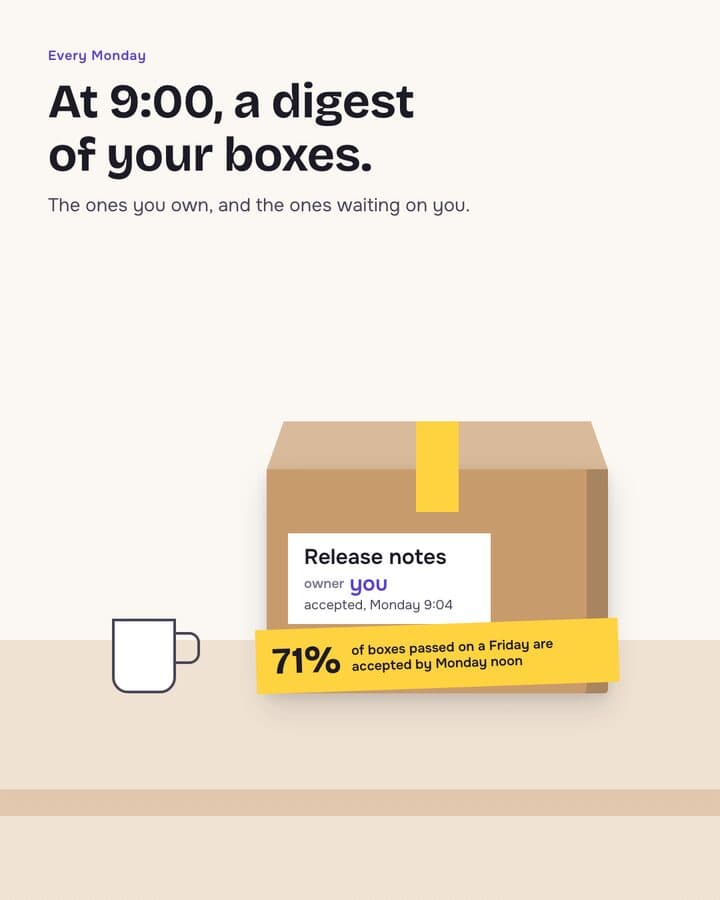
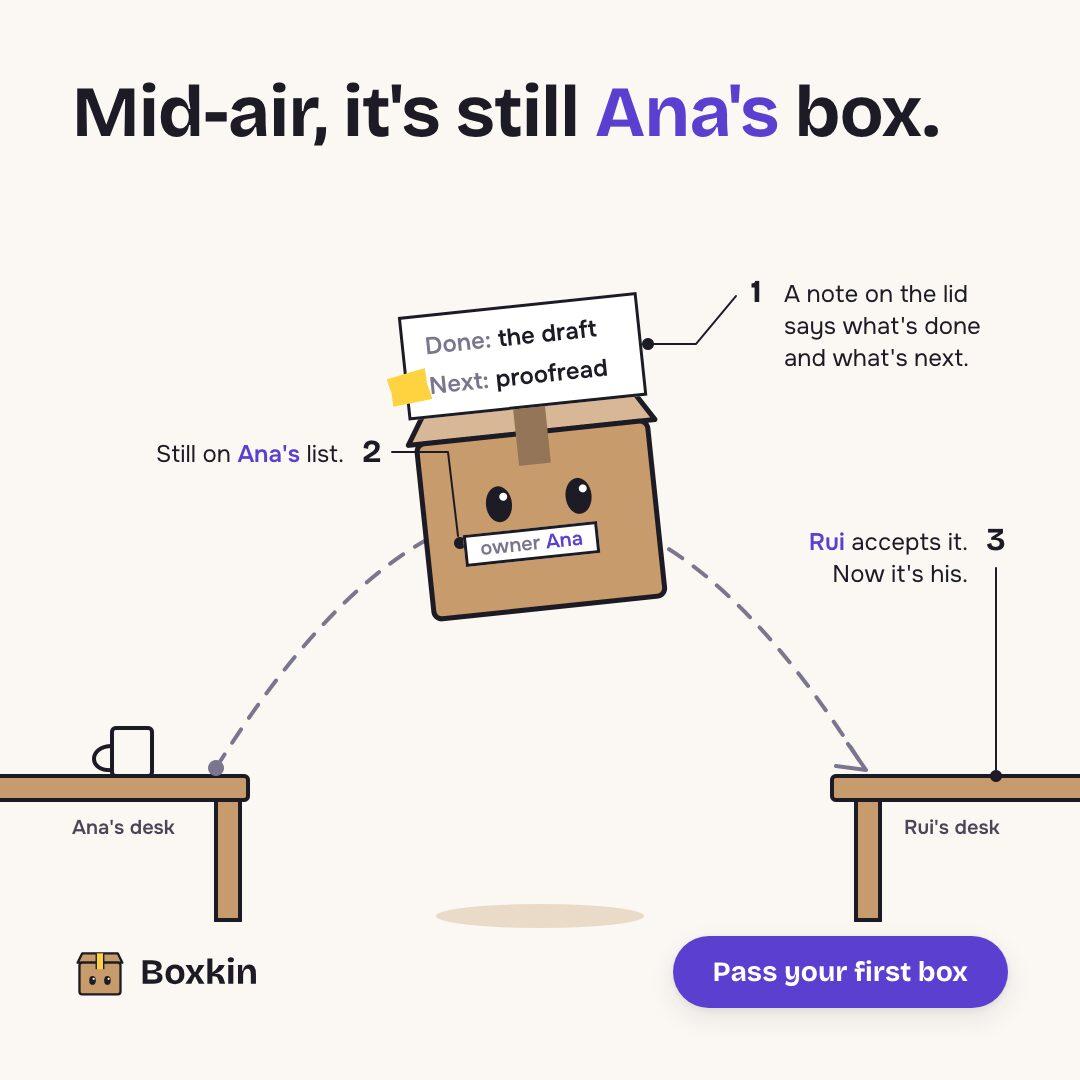
That week we decided every piece of work should have one owner at a time. In Boxkin each task is a box. To pass a box on, you write a note: what is done, what is next. The next person accepts it, and only then is it theirs. Every Monday at 9:00 each person gets a digest of the boxes they own and the boxes waiting on them.
Free for up to 3 people. Start free at boxkin.example.
Alt text
Slide 1: A plain kraft box labelled "Release notes", its owner line blank, sits on a desk next to a mug. Text: "How Boxkin started. We each thought the other had the release notes."
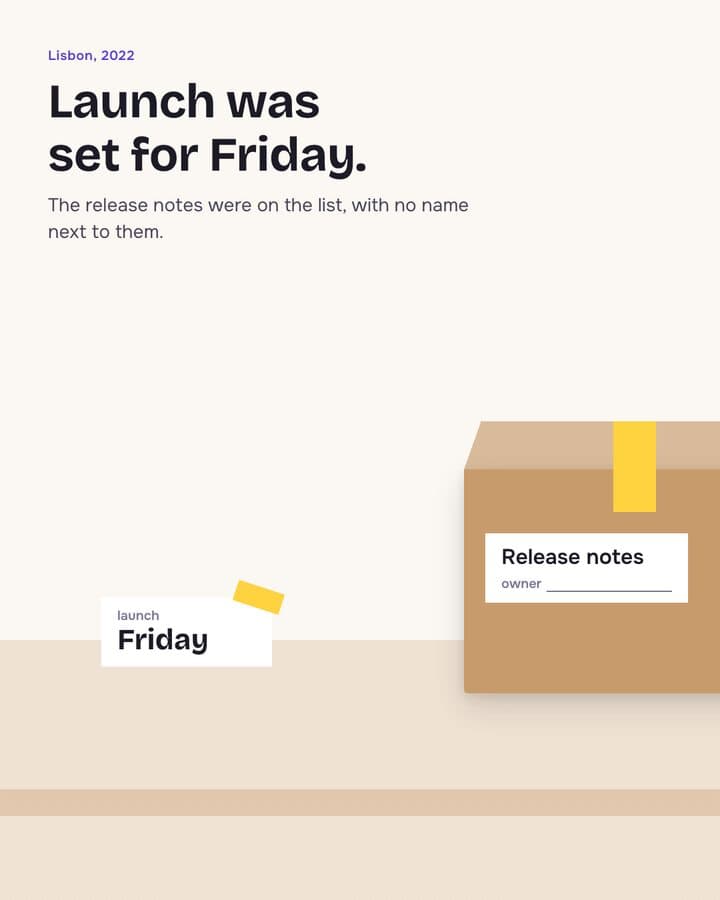
Slide 2: The box has moved along the desk past a paper tag taped down that reads "launch Friday". Text: "Lisbon, 2022. Launch was set for Friday. The release notes were on the list, with no name next to them."
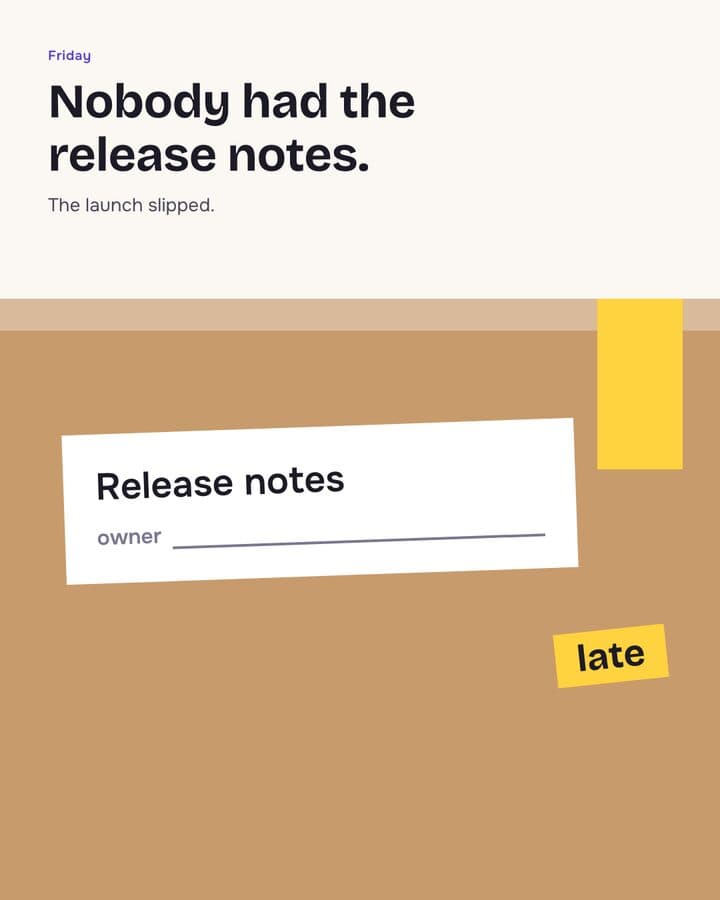
Slide 3: A close-up of the box front: the "Release notes" label with an empty owner line, and a strip of yellow tape that says "late". Text: "Friday. Nobody had the release notes. The launch slipped."
Slide 4: Looking down at the desk: the box top is taped shut, a note taped on it reads "Done: the first draft. Next: proofread, then post." Text: "That week. A box has one owner at a time. To pass it on, you write what is done and what is next. It becomes theirs when they accept it."
Slide 5: The box on the second desk, its label now reading "owner you, accepted, Monday 9:04". A strip of yellow tape across the front reads "71% of boxes passed on a Friday are accepted by Monday noon". Text: "Every Monday. At 9:00, a digest of your boxes. The ones you own, and the ones waiting on you."
Slide 6: The Boxkin logo above the line "One owner per box, and a note when it moves." and a violet "Start free" button.
What the record says
The approval lines from production/signoffs.md, the file where each approval is written down, and the checks stored with the kept sample.
- brief-locked: 2026-10-01
- winner-approved: 2026-10-01 · winner: V1
- Framing
- the 2022 slip as a chain of small pushes: plan, two people, the box between them, Friday, the slip, the note
- Structure
- 6 slides as one panorama: 1 launch week, box on the desk; 2 and 3 each person nudges it toward the other; 4 the box stops in the gap; 5 the launch date moves; 6 the box with a note on its flap, accepted, Start free pill
- Tone
- dry and specific, one short line per slide, the box does the telling
- Preflight
- pass
- Check desk
- pass
- Checked
- 2026-10-01
- Kept in the sample library
- 2026-10-02
Kamply is $69 a month or $499 a year. It runs on your own Claude Code or Codex subscription.
Keep looking.
- How Kamply makes thisAI content generator
- The size specInstagram feed post
- Every pieceThe whole showcase
More from Boxkin
Sample brands from the app’s library
Darnfold, Boxkin, Woofstead and Latelift are invented brands, so every figure in their work is fictional.
 sample brand
 sample brand
 sample brand1 / 3
Bring one brief to the walkthrough.
We build the first direction with your brand during the walkthrough.