

Brand systems
Why AI marketing drifts off brand, and what fixes it
The short version
- Prompt-based tools re-decide your colours, type and voice on every generation, so drift is the default outcome, not an accident.
- A brand a machine can hold is a set of tokens: exact colours, named type roles, spacing, and voice rules derived once from your site.
- Consistency has to be enforced by checks that can fail a deliverable, because a human reviewer's attention span doesn't scale.
Kamply is a Mac app that builds posts and reels with you, on your brand. It works with your own Claude Code or Codex subscription. See pricing.
The failure is structural, not a bad prompt
Ask a general-purpose AI tool for a launch post on Monday and a follow-up carousel on Thursday and you get two pieces that could belong to two different companies. That isn't a skill problem you can prompt your way out of. Each generation starts from nothing: the model re-decides the palette, the type feel, and the voice every time, and 'make it match Monday's post' is an instruction it can only approximate.
Teams patch this with brand guideline PDFs pasted into prompts. It helps the way a sticky note helps: sometimes, partially, and never twice the same way. The guideline was written for a human designer who reads it once and internalises it. A generation pipeline needs something it can reference mechanically.
What a brand is to software: tokens
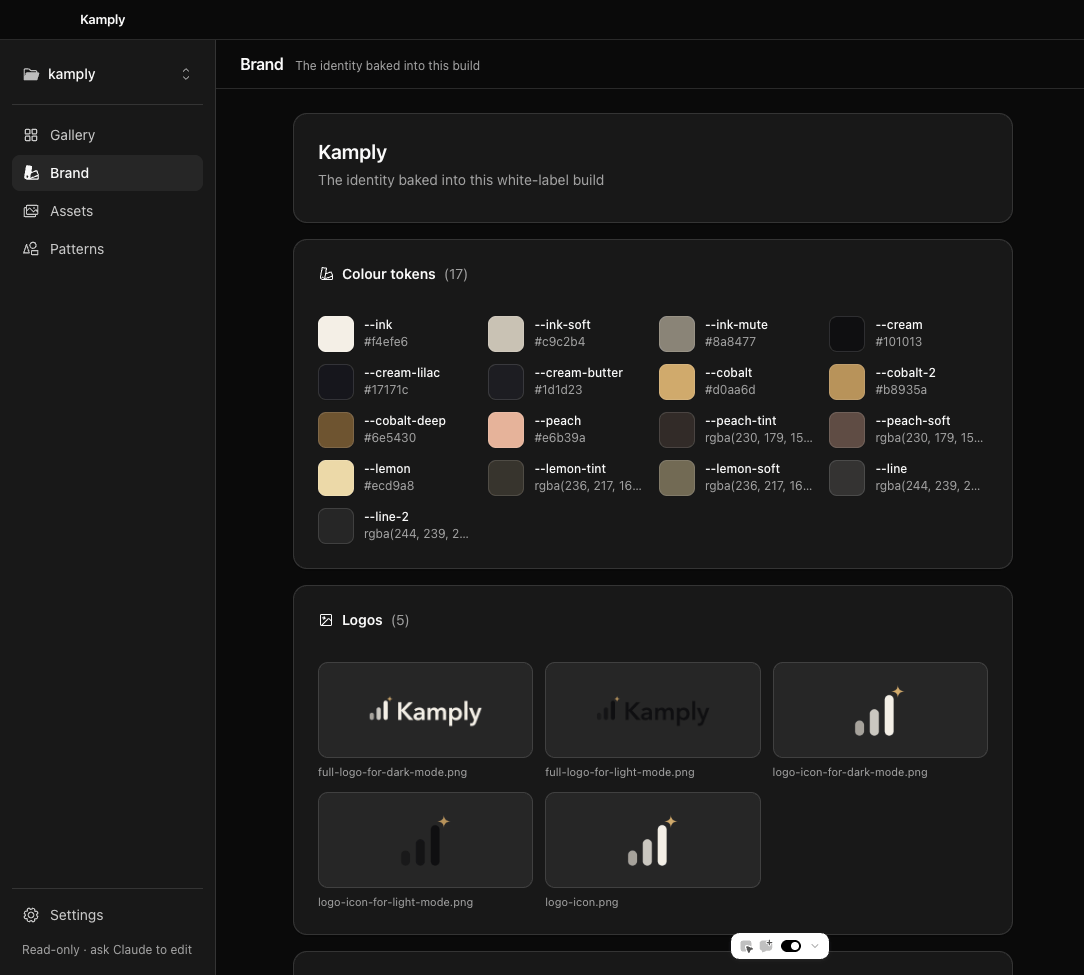
To a designer, a brand is taste. To software, a brand has to be data: the exact background colour, an accent with rules about where it may and may not appear, one display face and one body face with fixed weights, a spacing scale, and voice constraints concrete enough to check a sentence against.
That artifact is usually called design tokens. Once the brand exists as tokens, 'on brand' stops being an opinion and becomes a property a build either has or doesn't, the same way code either compiles or doesn't.
Derive once, reference everywhere
Kamply's onboarding does the compilation step: it reads your website, interviews you about the judgement calls a scrape can't make, and writes the result as tokens for colours, type roles, spacing, voice, and logo variants. Every deliverable after that references the tokens instead of restating the brand from memory.
This is why the hundredth post matches the first. Nothing is remembering the brand; everything is reading it from the same file.
The check that has to be able to fail
Tokens alone aren't enough, because generation can still drift inside them: a colour used where it shouldn't be, a headline set bolder than the brand allows. So the second half of the fix is gates: automatic checks that treat an off-palette colour, a second font weight, or an unsourced number as a defect that stops the work.
The important property is that the gate fails the deliverable rather than warning about it.
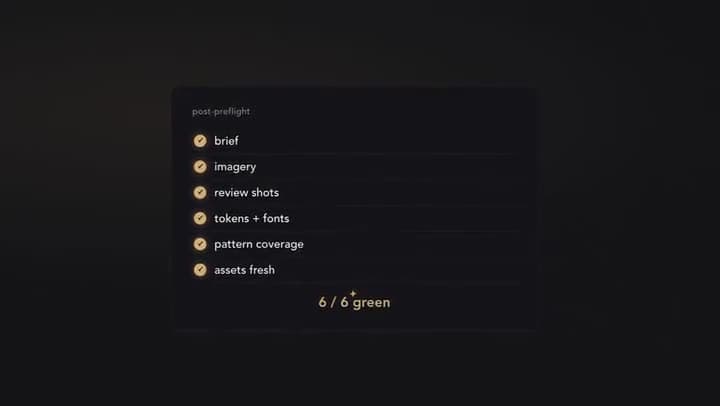
Advice gets skipped on a busy Thursday. A hard failure doesn't.
What you do in this system
You approve. Kamply interviews you, locks a brief, proposes labelled variants built on your tokens, runs its checks, and then waits. Your taste stays the final gate; it's just spent on choosing between finished on-brand options instead of policing drift. If you're wondering what that feels like day to day, the founders page walks through the standing jobs.
Questions this post answers
- Can't I just paste my brand guidelines into a prompt?
- You can, and it will help inconsistently. A guideline document is written for humans; a generation pipeline needs machine-readable tokens plus checks that fail work which drifts from them.
- What are design tokens?
- Named, exact values for a brand's colours, type, and spacing: the brand as data instead of as a PDF. Kamply derives them from your website plus a short interview, then every deliverable references them.
- Does this mean every post looks the same?
- It means every post looks like the same brand. Layouts and visual ideas vary per piece, since Kamply proposes differently-led variants, while colours, type, and voice hold still.